


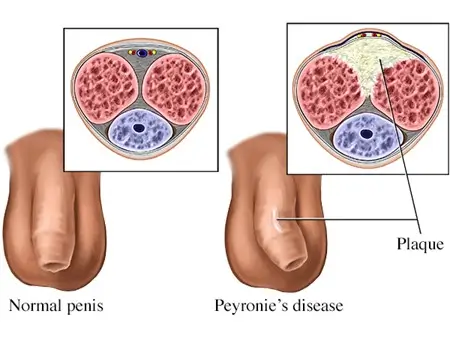
What Is Peyronie’s Disease?
A man is diagnosed with Peyronie’s disease when fibrous scar tissue develops on the penis and causes curved, painful erections. When a man becomes sexually aroused, blood flow to the penis increases, leading to chambers on either side of the penis to fill with blood and stiffen. Peyronie’s disease causes the penis to become disfigured because the region with scar tissue cannot stretch to compensate for the additional blood flow. Penises vary in shape and size, and having a curved erection is no cause for concern. But this disease causes a significant bend or even pain for some men. This can prevent or discourage men from having sex, and many men have stress or anxiety as a result. Peyronie’s disease rarely goes away on its own, and it remains as it is or worsens with time. Early treatment offers the best chance of preventing symptoms from worsening or even improving symptoms altogether.
Some bothersome symptoms include:
- Scar tissue that can be felt under the skin of the penis is a band of tissue or a band of hard tissue.
- Significant bending, or directional curvature of the penis
- Erectile Dysfunction, or problems getting and maintaining an erection, is often reported before Peyronie’s disease symptoms are noticed.
- Shortening of the penis
- Penile pain, with or without an erection
- Penile deformity, such as narrowing, indentations, or even an hourglass-like appearance, with a tight band around the shaft.
- Abnormal penile curvature
Risk Factors That Increase the Likelihood of Developing Peyronie’s Disease:
- Aging
- Diabetes
- Tabacco use
- Penile injury
- Family history (relatives who have had this disease)
- Connective tissue disorders